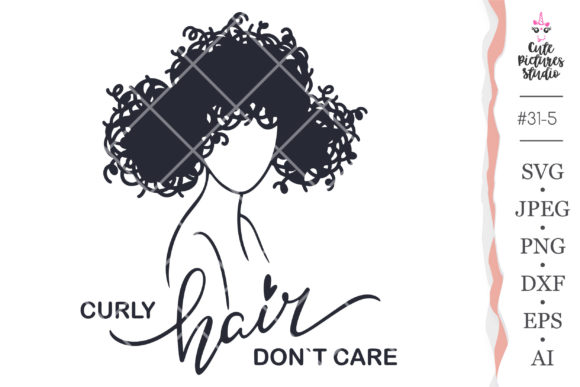
Curly Hair Don't Care: A Designer's Review
As a designer who has spent years navigating the intersection of digital graphics and physical stitching, I approach every new machine embroidery design with a critical eye. The market is flooded with files that look stunning on a screen but fall apart under the needle. When I first opened the file for Curly Hair Don't Care, Woman Portrait, I wasn't just looking at another vector; I was evaluating its potential as a viable asset for my craft business and client projects. This piece falls squarely into the Crafts category, specifically within the realm of expressive Graphics, but its true value lies in how it translates from a flat SVG to a textured, three-dimensional reality.
The First Impression: Minimalism Meets Attitude
The initial visual impact of Curly Hair Don't Care, Woman Portrait is defined by its clean lines and confident posture. As an Oneline art svg, it relies on continuous flow rather than heavy fill areas. This aesthetic creates a mood that is both modern and empowering. For an Etsy seller or a boutique owner, this kind of minimalism is gold. It speaks to a customer base that values subtlety and wit over loud, cluttered designs. The portrait captures the essence of the "curly hair" movement without needing excessive detail, making it instantly recognizable even from a distance.
However, the simplicity of a one-line drawing presents specific challenges in embroidery. In the world of digital product sellers, we know that what works for a Cricut cut file does not always work for a sewing machine. The thin lines that make this Poster minimalism svg so effective digitally can become fragile if the stitch density is too low. My immediate thought upon reviewing the layout was: "How will this hold up on a stretchy fabric?" The answer depends entirely on the execution of the digitization behind the scenes.
Real-World Application: From Tote Bags to Sweatshirts
To truly understand the utility of Curly Hair Don't Care, Woman Portrait, I imagined a specific scenario: creating a limited run of custom embroidered tote bags for a local beauty salon. These bags would serve as promotional items for clients who pride themselves on their natural texture. The design fits perfectly here. The single-line style allows the thread to stand out against the canvas of the bag without overwhelming the material.
I also considered using this as a sweatshirt embroidery project. Placing the woman's portrait on the left chest of a heavyweight hoodie offers a professional yet playful look. Because the design is a Barbershop beauty logo candidate, it could easily be adapted for staff uniforms or branded merchandise. The key advantage here is versatility. Unlike complex portraits that require hundreds of color changes, this design likely utilizes fewer thread colors, reducing production time and cost—a crucial factor for any small shop product line.
For those focusing on personalized gifts, this design shines on pillow covers or kitchen towels. Imagine a holiday gift set where the recipient receives a cozy towel featuring this witty portrait. The message resonates deeply, turning a standard household item into a statement piece. However, when moving from flat surfaces like towels to curved surfaces like caps, caution is required. The continuous line might distort if the cap curve is too aggressive, potentially breaking the flow of the hair curls.
Navigating Fabric and Hoop Constraints
Every experienced designer knows that the fabric dictates the success of the project. While Curly Hair Don't Care, Woman Portrait looks great on paper, you must consider the fabric texture. On thick, textured fabrics like denim or heavy canvas, the fine lines of the one-line art might get lost. You would need to increase the stitch count or use a thicker thread to ensure visibility. Conversely, on thin or stretchy fabrics like jersey knit, the risk of puckering is high. Using the correct stabilizer is non-negotiable here. Without a tear-away or cut-away stabilizer that supports the weight of the thread, the delicate lines could warp the garment.
Regarding hoop size, this design appears compact enough for smaller hoops, which is excellent for adding accents to baby clothes or aprons. However, if you are planning to use it as a large focal point on a blanket or throw, you must ensure the scaling doesn't compromise the integrity of the line work. Scaling up a one-line design too much can expose gaps between stitches, leading to a jagged appearance. Always test the design on scrap fabric first to confirm the running stitch or satins stitch settings maintain smoothness.
Commercial Viability and Brand Consistency
For the creative entrepreneur building a brand, consistency is key. Curly Hair Don't Care, Woman Portrait offers a distinct visual identity that can anchor a collection of handmade products. Whether you are selling embroidered patches or full custom apparel, this graphic provides a cohesive theme. It signals inclusivity and confidence, values that many modern consumers seek in their purchases.
When preparing printable mockups for your online store, this design performs exceptionally well. Its clean lines translate clearly in digital previews, helping customers visualize the final result. This clarity builds buyer engagement and trust. Customers are more likely to purchase a finished product when they can see exactly how the design will look. However, remember that a digital preview cannot capture the sheen of the thread or the texture of the fabric. Managing expectations through honest descriptions is part of the professional process.
Practical Notes for the Designer
Before committing to a large batch of orders, there are several practical steps you must take. First, verify the licensing terms. If you plan to sell finished goods containing Curly Hair Don't Care, Woman Portrait, ensure your license permits commercial use. Some digital embroidery file licenses restrict the number of items you can sell or require attribution.
Second, conduct a color study. While black thread often works best for one-line art, experimenting with contrasting thread colors can elevate the design. Try a deep burgundy on a cream background or a bright teal on navy blue. Test these combinations on dark and light fabric backgrounds to see how the visibility holds up.
Finally, inspect the small details. Zoom in on the digitized file to check for sharp corners or tight curves that might cause thread breaks. If the file includes tiny lettering alongside the portrait, consider simplifying it for embroidery, as text under 0.5 inches often becomes illegible after stitching. By taking these precautions, you ensure that your craft business delivers high-quality results that stand the test of time and washing.
In conclusion, Curly Hair Don't Care, Woman Portrait is a strong contender for your design library. It balances artistic flair with practical application, making it suitable for everything from baby embroidery to commercial embroidery projects. With careful attention to stabilizers, fabric choice, and testing, this Graphics asset can become a signature element of your handmade offerings.